Featured Science
India's space programme has long been a symbol of scientific excellence and technological self-reliance. From the launch of Aryabhata in 1975 to the successful Chandrayaan and Mars Orbiter missions, the Indian Space Research Organisation (ISRO) has demonstrated that world-class achievements are possible through innovation and perseverance. Today, however, India is entering a new era in which private enterprises are joining hands with government institutions to shape the country's future in space.
The upcoming orbital launch of Vikram-1, developed by Skyroot Aerospace, marks a significant milestone in this transformation. More than the maiden flight of a privately developed rocket, it reflects the emergence of India's vibrant "NewSpace" ecosystem, where startups, academia, industry, and government collaborate to expand the nation's presence in the global space economy.
Unlike the early decades of space exploration, when activities were largely driven by national prestige and geopolitical competition, today's space industry is increasingly commercial. Satellites now support weather forecasting, navigation, telecommunications, disaster management, agriculture, banking, environmental monitoring, and countless digital services. Advances in miniaturisation, reusable technologies, and manufacturing have reduced the cost of accessing space, creating opportunities for universities, startups, and private companies to participate alongside national space agencies.
India is well positioned to benefit from this transition because of its strong scientific base, highly skilled workforce, cost-effective engineering, and progressive policy reforms. For students, this evolution has opened exciting career opportunities in aerospace engineering, artificial intelligence, robotics, remote sensing, electronics, data science, materials engineering, and software development.
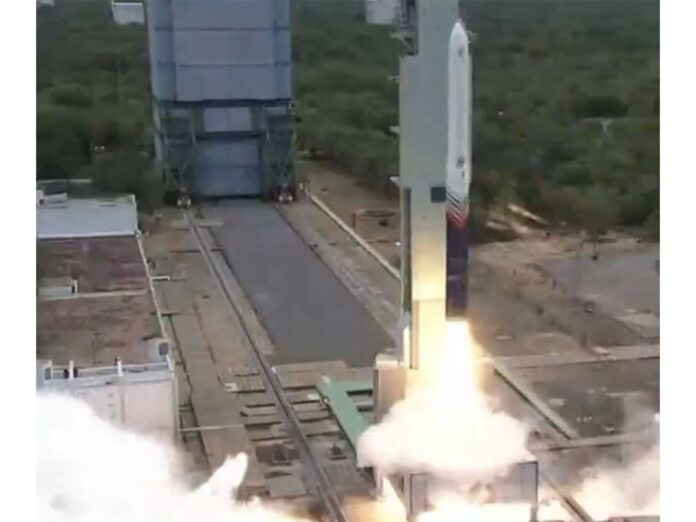
Skyroot’s Vikram-1 lifts-off from Sriharikota
The Science Behind Orbital Rockets
Although a rocket launch appears simple, placing a satellite into orbit is one of engineering's greatest challenges. Crossing the Kármán Line, about 100 kilometres above Earth, qualifies as reaching space, but remaining in orbit requires a spacecraft to attain a speed of nearly 7.8 kilometres per second (about 28,000 km/h). At this velocity, the satellite continuously falls around Earth instead of returning to the surface.
Since rockets carry enormous quantities of propellant, nearly 90 per cent of their launch mass consists of fuel. Engineers therefore seek to minimise structural weight while maximising engine efficiency. One of the most effective solutions is multi-stage rocket design, in which empty fuel tanks and engines are discarded during ascent, allowing the remaining stages to accelerate more efficiently.
Modern launch vehicles also benefit from advances in carbon-fibre composite materials, which are lighter and stronger than conventional metals. Vikram-1, for example, incorporates an all-carbon composite structure that improves payload capacity while reducing weight. Another important innovation is 3D printing, or additive manufacturing, which enables complex rocket engine components to be produced as single integrated structures, reducing manufacturing time, cost, and assembly complexity.
Rocket propulsion is based on Newton's Third Law of Motion: every action has an equal and opposite reaction. By expelling hot gases at extremely high speed through a nozzle, the rocket generates the thrust needed to overcome Earth's gravity. Modern launch vehicles often combine solid rocket motors, which provide powerful lift-off thrust, with liquid propulsion systems, which offer greater control and precision for placing satellites into their intended orbits.
Most commercial satellites are deployed into Low Earth Orbit (LEO), between approximately 160 and 2,000 kilometres above Earth's surface. LEO is ideal for Earth observation, communications, navigation, and scientific research because satellites orbit the planet quickly and provide high-resolution data with relatively low communication delays. However, the increasing number of satellites has also raised concerns about space debris, making sustainable space operations an important priority for future missions.
Policy Reforms Driving Private Participation
Scientific excellence alone cannot build a thriving commercial space sector. It must be supported by policies that encourage innovation and investment. India's recent reforms have created such an environment by opening the space sector to private participation.
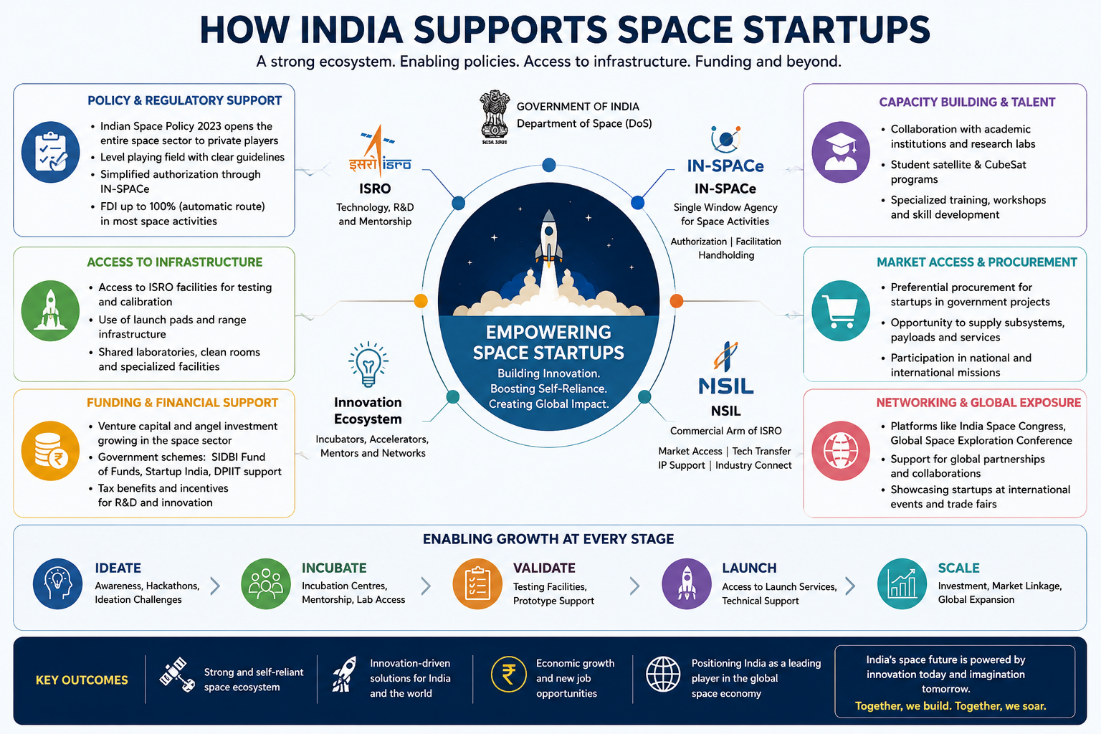
The Indian Space Policy 2023 allows non-government entities to participate across the entire space value chain. The establishment of the Indian National Space Promotion and Authorisation Centre (IN-SPACe) provides regulatory support and facilitates access to ISRO's testing facilities and infrastructure. Meanwhile, NewSpace India Limited (NSIL) promotes the commercialisation of ISRO-developed technologies.
These initiatives have encouraged the rapid growth of Indian space startups working in launch vehicles, satellites, propulsion systems, Earth observation, communications, and geospatial technologies. They demonstrate how government support and entrepreneurial innovation can complement one another to strengthen the national space ecosystem.
Economic Opportunities and Future Challenges
The global space economy is expanding rapidly, with estimates suggesting that it could exceed US$1 trillion over the coming decades. India aims to become a major contributor through cost-effective launch services, satellite technologies, and downstream applications that support agriculture, disaster management, climate monitoring, healthcare, and digital communications.
The benefits of space research extend well beyond space missions themselves. Advances in materials science, electronics, artificial intelligence, robotics, telecommunications, and manufacturing often find applications in everyday life, driving innovation across multiple sectors of the economy.
For students and young researchers, this changing landscape offers diverse career opportunities. In addition to aerospace engineering, the space sector increasingly requires expertise in computer science, cybersecurity, biotechnology, environmental science, remote sensing, and business management. Universities are also encouraging participation through CubeSat projects, interdisciplinary research programmes, and industry collaborations.
Despite this progress, important challenges remain. Commercial launch providers must compete globally while maintaining reliability, affordability, and technological excellence. The growing accumulation of orbital debris demands responsible mission planning and international cooperation. Sustainable launch technologies, reusable rockets, and environmentally friendly manufacturing practices will become increasingly important as space activities continue to expand.
Looking Ahead
The launch of Vikram-1 represents more than the success of a single company. It symbolizes India's transition from a government-led space programme to a collaborative ecosystem in which public institutions, private industry, academia, and entrepreneurs work together to advance scientific and technological progress.
India's future in space will depend not only on the number of rockets it launches but also on its ability to integrate research, innovation, skilled human resources, and supportive policies into a sustainable and globally competitive ecosystem. As the country embraces this new era of commercial space exploration, the next generation of scientists, engineers, and innovators will play a crucial role in shaping its future.
The private space revolution has only just begun. If nurtured through continued research, responsible policies, and sustained investment, it has the potential to transform India into one of the world's leading spacefaring nations while inspiring countless young minds to reach beyond the boundaries of Earth.
Timeline of India's space journey: Aryabhata to Vikram-1.
| Year | Milestone | Significance |
|---|---|---|
| 1962 | Establishment of INCOSPAR | Formation of the Indian National Committee for Space Research under Dr. Vikram Sarabhai, marking the beginning of India's space programme. |
| 1969 | ISRO Established | Indian Space Research Organisation (ISRO) was established to develop indigenous space capabilities. |
| 1975 | Aryabhata | India's first satellite launched, marking the country's entry into the space age. |
| 1980 | SLV-3 Launch | Rohini satellite successfully placed into orbit by India's first indigenous Satellite Launch Vehicle. |
| 1994 | PSLV Operational | Polar Satellite Launch Vehicle became India's highly reliable workhorse for launching satellites. |
| 2001 | GSLV First Flight | Geosynchronous Satellite Launch Vehicle expanded India's capability to launch heavier satellites. |
| 2008 | Chandrayaan-1 | India's first lunar mission confirmed the presence of water molecules on the Moon. |
| 2013–14 | Mars Orbiter Mission (Mangalyaan) | India became the first country to reach Mars orbit successfully on its maiden attempt. |
| 2017 | 104 Satellites in One Launch | PSLV-C37 set a world record by launching 104 satellites in a single mission. |
| 2020 | Space Sector Reforms | Government opened the space sector to private participation and established IN-SPACe. |
| 2022 | Vikram-S Launch | Skyroot Aerospace successfully launched India's first privately developed rocket, demonstrating private-sector launch capability. |
| 2023 | Indian Space Policy 2023 | Comprehensive policy enabling private participation across the space value chain. |
| 2023 | Chandrayaan-3 | India became the first nation to achieve a soft landing near the Moon's south pole. |
| 2024 | Aditya-L1 | India's first solar observatory reached the Sun–Earth L1 point for continuous solar observations. |
| 2025–26 | Mission Aagaman & Vikram-1 | Skyroot Aerospace prepares India's first privately developed orbital launch vehicle, marking a new era of commercial spaceflight. |
Selected Source: Department of Space, Government of India. Indian Space Policy 2023.
• Indian Space Research Organisation (ISRO). Annual Report 2024–25.
• Indian National Space Promotion and Authorisation Centre (IN-SPACe). Annual Report 2024–25.
• NewSpace India Limited (NSIL). Annual Report 2024–25.
• Government of India. Space Sector Reforms (2020 onwards).